Famously, once we humans have learned and conquered something new, we can’t go back to what we used to do. A perfect example of this is small children who have learned to crawl, once they learn to walk and run, they can’t go back, they don’t go back to crawling.
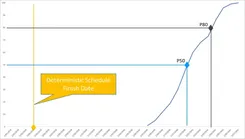
I’ve found it’s the same in the mine scheduling world. Once you start thinking about stochastic scheduling and working with it, you can’t go back. You can’t go back to deterministic scheduling. I personally have been amazed at the step-change in my thinking, since I’ve started on this journey of advocating for change away from deterministic thinking to stochastic thinking. In case you haven’t read any of my previous articles, deterministic scheduling involves the use of singular assumptions (or build-ups) for task durations, while stochastic scheduling builds uncertainty into the plans, so variability around production times and rates.
For many years now I have thought that we should be stochastic scheduling. But as the scheduling software out there hasn’t had that capability, it has been left in the realm of simulation software instead, I’ve never spent too long dwelling on it. But recently, my thinking has changed as I have continued to question why we schedule deterministically instead of stochastically. I think that deterministic scheduling is one of the biggest downfalls in mine planning today, particularly given our coding and hardware ability. I really do fail to see why stochastic scheduling capability is not industry-standard in our mainstream mine scheduling software.
And as I said, once you start thinking about it, you can’t go back!
This experience has been an awesome transformation for me, even at my tender age of 56, with over 30 years in the mining industry. Following the research carried out and examples I have compiled for previous articles, I now appreciate even further the pure folly of deterministic scheduling. How it really is the root of all evils in mine planning. We have such a complex set of processes in mining, with so many activities, so many dependencies between them, and an incredible amount of uncertainty in every task. And we think that we can create a schedule that is a single snapshot in time, with one clearly defined plan and outcome, that is simply just crazy!
But what is even more ridiculous, is that we put so much faith in these deterministic plans that we measure their performance, and we measure people against them. As I’ve written previously, compliance to plan, as in measuring if equipment is in the right location at the right time is a terrible measure. It places a blind faith and belief in our mine plans that is undeserved and shows a complete lack of understanding of the variability that exists in mining processes.
So, having ceased to agree with deterministic schedules as having the high value we place on them, I now find my thinking has moved into a totally different sphere and I believe a significantly more valuable one at that. Here are some examples of the questions I now think about, some of which I have reflected on in past articles, some of which will be discussed in my future articles.
- Where in the process, should we carry inventory?
- Which is more cost-effective for reducing slippage, carrying inventories, or reducing variability?
- What is the real cost of not meeting the plan?
- Should we be using the critical path approach in mine scheduling?
- Slippage is definitely a critical issue in short-term plans, but how critical is it in medium-term and long-term plans?
- Is it flexibility in the mine schedule that allows us to get away with deterministic scheduling?
- What is the cost of having this flexibility in our planning?
And I would note that these examples are just the tip of the iceberg. Now that I’ve “learned to walk” and started thinking about these questions, I’ll only continue to think this way and will find many other issues to explore. I firmly believe we need more people thinking this way in the industry and challenging paradigms, it is for the good of the industry. So hopefully my series of articles have either started this journey for you or spurred you to up the ante on an industry move to stochastic scheduling.