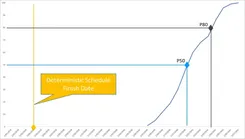
You know mining tasks have a high degree of variability around how long they take and want to build that into your schedules, so what should you do? Well, Liam (a reader of my articles) asked me a couple of questions, the first of them was this “Is there any software that makes weekly scheduling more stochastic? Or is just being realistic the Crux of it?”
Great question!
As mentioned in Article 17, unfortunately, I haven’t come across any software that includes stochastic functionality, which in my opinion is ridiculous. So while we’re waiting for that capability, what do we do about it for now?
Liam is right on to it because stochastic scheduling is not only about producing a schedule in software with ranging around the task times, but it is just as much about the mindset. And that is not just your mindset, but the mindset of a large range of people at your mine. It is about stepping over the hurdle of assuming that a deterministic plan is right. It is about ceasing to think and talk like you can actually hit those milestones that are dictated in the deterministic schedule. It is about understanding that there is variability inherent in the execution of a schedule and you’ll never achieve 100% execution of the plan.
So therefore, it is not a matter of fixed time slots for each task, but instead, that every single task within the schedule will have a range of times within which it will both start and finish. This will then impact the interaction between tasks, and therefore whether the timing of downstream tasks is further affected. While a schedule with every task scheduled on a stochastic basis would highlight that beautifully, we don’t currently have that capability.
And so therefore, what is it that we can do to help shift the mindset?
I believe the solution lies in manually implementing what the schedule should automatically be doing. My recommendation is to choose the most critical tasks within the schedule, and then carry out your own ranging around the possible start and completion times for those tasks. The person who carried out the schedule will inherently have a good feel for what are the most critical tasks. But the items that I would consider when determining those critical tasks are as below.
· Those tasks with the lowest lag between tasks and therefore have the highest probability of the second task being delayed by the first task.
· Secondly, I would consider those tasks that are critical in the flow of the schedule achieving its key targets. For example, often in a schedule there are key blocks of ore that are required for the blend, or a task that if it runs late is going to hold multiple other tasks within the schedule.
With these critical tasks selected, then apply a range of finish dates to them. That range can be determined by analysing historical production rates for the relevant equipment and subsequently determining the potential variability. That variability will allow you to work out a range of times within which that task might finish. Then, instead of talking specific dates that the task will finish (like one does with deterministic schedules), instead start referring to the range of times within which it might finish. Even better still, also start referring to the probability that it will not finish by a constraining date, creating an issue with a task downstream of this interaction. The key element here is the language that will be used, it is not a language about specific end dates, but instead one of date ranges and percentage likelihoods of there being an issue.
Mine schedules are not just about working out how the mine will achieve certain targets and the sequencing of equipment required. A plan is also about managing risk and risk is caused by uncertainty (variability). Talking in a language of probabilities that an event will occur, is identifying the risk and putting it squarely on the table for monitoring and management.
I would recommend choosing a fixed number of the most critical items and carrying out this process every short-term schedule. How many critical items are selected depends on how much time you have available, as this step does increase the labour time required in each schedule. So you might have a Top 3, a Top 5, or even a Top 10 critical tasks. But choose a fixed number and start to manually carry out this process and start the transition to talking in a different language.
I could be wrong and I might need to further test this hypothesis yet, but at this time I don’t believe this manual process is necessary for mid-term or long-term schedules.
Manually carrying out the ranging process will also assist the transition to automation when that time comes. Why? I’ve always been a big believer in that to get process automation right, you need to have the depth of understanding that comes from having done it manually yourself beforehand.
That’s my recommended solution until such time as suppliers can provide us scheduling software with stochastic capabilities. Let me know how you go!