In identifying and writing about ten mine planning crimes, there were two crimes that stood head and shoulders above the other eight, these were deterministic scheduling and optimistic plan inputs. We can not continue to ignore these two crimes, for the sake of stabilising the mining industry we have to change. It just so happens that Zac Ryan agrees with me, based on his experiences he had previously written an article on optimistic mine plans. I think his article explains the issue very well and really hits the nail on the head. He has kindly allowed me to post it for the benefit of the industry. So the below article is not my writing, but Zac can take the credit for it all.
Risk evaluation is the core of any mining company, before each and every task we must evaluate the likelihood and consequence of an event occurring and put in suitable controls to ensure the risk is at an acceptable level. When it comes to predicting how much a mine can produce, however, all fundamentals of risk evaluation are lost. There is no malice in this reality but rather an insight into what is the least understood outcome of what a mine schedule is designed to do. There is no doubt that there are core beliefs that a mine schedule is there to inspire, by aiming for the sky, we can stretch our capability. It is with this fundamental philosophy we inadvertently drive inefficiency. The cycle of this inefficiency is repetitive and a closed feedback loop. It drives further inefficiency until a process is stopped and the only way forward is fundamental changes.
A mine schedule is not complicated, we quantify volume through design and we quantify volume in time through our assumptions. The time to complete core tasks are based on:
1. How quickly we can do them and;
2. How many productive hours there are in a day.
Volume is an easy component to quantify, we design the excavation and can determine down to the decimal place exactly how much there is to remove. Productivity and hours however are based on what we “think” will happen. This is where the variability can occur, instead of basing our estimate of productivity and operational hours on what we know we have done, we inadvertently put variability into our forecast. Believing if we put in stretch targets we will push ourselves further. The reality is, this hides the challenges of the future we are trying to predict, we can’t see when processes are actually going to be completed because they are accelerated so far by our assumptions. Instead of seeing an issue, we see a sequence working efficiently, for example:
1. An excavator clears waste to a coal seam
2. Coal mining is forecast to be mined before the end of the month. Everyone is happy.
However, as we progress through execution, the volume is moved at historical performance, not the stretch target. The slower normal rate of movement pushes coal out of the month and the non-compliance to plan begins, we change the plan trying to recover shortfalls and maintain guidance which ultimately brings further delays into the plan. This sequence would most likely occur every week in every mine across the country. Our desire for more resources outweighs our desire to be efficient. We inadvertently hinder our ability to be efficient through our lack of control over assumptions. Our current planning process has no logic, it is driven by emotion and the inability to have tough realistic conversations. We are destined to repeat the same failures over and over again without the ability to learn, all due to the human factor on assumption manipulation to goal seek a production output.
Now imagine this on a grander scale. Imagine longer-term models that are embedded with stretch where shortfalls can compound year on year. The forecast shows a long-term mine output that yields excellent cash flow, it negates requirements for future capital as the output is inflated by aspirational manipulation. Instead of seeing when cash flow decreases and when capital injection is required to sustain mine development, the time frame for capital is pushed past where it is required. The resulting degradation of asset performance is realised too late and output is hindered.
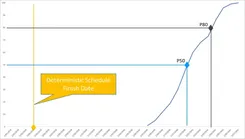
If we schedule based on the highest probability it will enable the scheduler to identify points in the sequence that aren’t likely to be completed in time and enact change prior to the event occurring. Making decisions on challenges in the mining sequence months or even years out in advance allows a compliant and stable plan, which gives people at the coal face confidence in the plan and drives the belief in their task. That’s right, mine schedules directly impact the culture of the people doing the mining! When a sequence is simple and the timing of each process is executed on time, we increase production time and reduce non-productive tasks, such as relocations. This cycle is the opposite of stretch assumptions, by reducing equipment moves the operating crew gain familiarity with their work environment as they aren’t being moved from one area to the next in the hope of accelerating short-term shortfalls.
What is the solution to ensure compliance to plan and improve efficiency? Acknowledging that embedding aggressive assumptions into mining engineering schedules is not the solution for stable plans. Schedules should be constructed based on data, science and calculated assumptions. They should be a basis of confidence that uses proven long-term historical performance to analyse the future to a high level of predictability. Once planned, then we apply our continuous improvement, which is applied outside of the engineered model so we quantify the risk that we are striving for in our targets. This way the risk, likelihood and consequence are defined which enables us to make value stream based decisions and in the longer term make our mines predictable and more productive.
It is time, time to remove the stretch from engineering models and become efficient.