It’s time for another story.
At the iron ore mine discussed in Article 1, while building each stockpile, we had 8 qualities we targeted in each stockpile construction, that stockpile construction being labeled as a “run”. Those qualities were as follows:
· Lump iron, alumina, phos, and silica content
· Fines iron, alumina, phos, and silica content.
For each run, we were provided specific numerical targets for each of the 8 qualities, based on grades of ore already at the port and upcoming shipments to customers. But we weren’t provided acceptable ranges for each of those 8 qualities. However, following many years of run construction, there were acceptable ranges either side for each of the qualities, for example:
· Lump iron could vary 0.2% either side of a target of about 62%.
· Fines iron could vary 0.4% either side of a target of about 58%.
· Fines alumina could vary 0.03% either side of a target of about 2.8%.
· Fines phos could vary 0.002% either side of a target of about 0.083%.
· Lump silica could vary 0.5% either side of a target of about 6%.
The first thing you may notice is the varying sensitivities of these quality parameters. For example, the allowable variation on lump silica of 0.5% is 8.3% of 6% – so the lump silica has an acceptable tolerance of +/- 8.3% around the target. However, the 0.2% allowable variation on lump iron is only 0.32% of 62% – so the lump iron has an acceptable tolerance of only +/- 0.32% around the target. Or put another way, lump iron is 26 times more sensitive to variation than lump silica.
The problem with this is that the grade controllers who scheduled the runs knew this. It was not possible for them to focus on 8 parameters at once while they were executing their plan. So they typically focussed on 3 of them very intently, 3 of them they tended to keep a cursory watch on and there were 2 parameters that were rarely monitored throughout the run. This became patently obvious when we had one run that was an absolute disaster. The key qualities were pretty well spot-on as the grade controller was heavily focussed on those, but the grade controller totally lost sight of silica and the lump and fines silica both finished up about 2% over their respective targets. The silica was so far off target, that the stockpile was basically unblendable at the port, which created substantial issues.
In response to this event, to ensure that all 8 qualities were relatively monitored, I created a new scheduling measure I called the Run Score. It was a score that represented how close the run was to being on target for all 8 qualities. After many discussions with stakeholders, I arrived at a weighting for each of the 8 qualities, I then multiplied that weighting by the discrepancy between target and planned for each of the 8 qualities and then summed those 8 numbers to arrive at an overall Run Score. I’ve copied a table with an example set of calculations below.
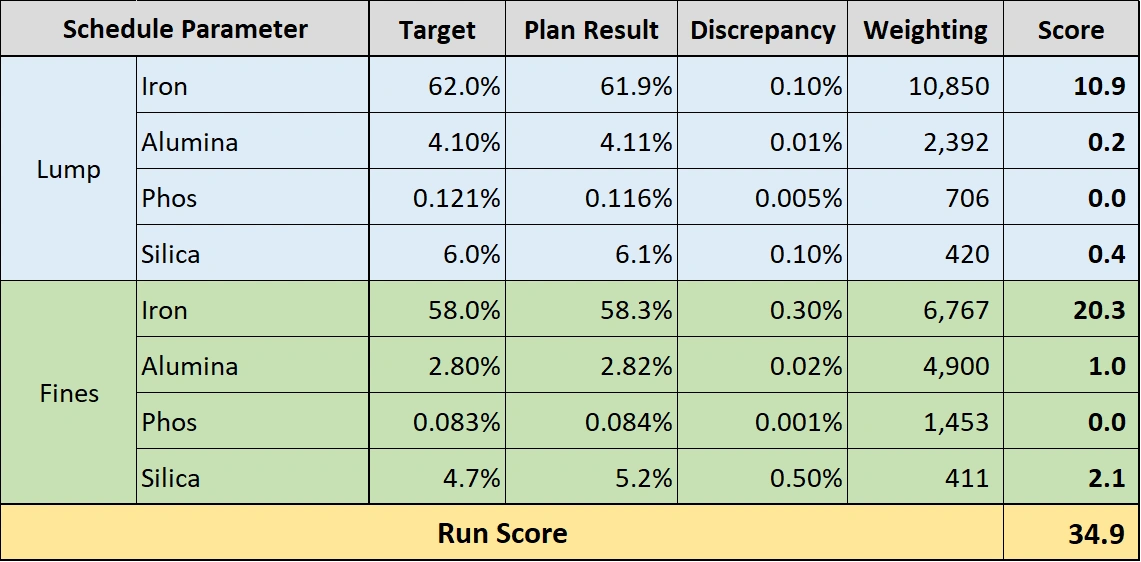
To arrive at the weighting factor in this example, I used the target for each quality divided by the allowable target band and then used a constant modifying factor for all parameters so that a score of 100 was a fairly bad result. Of course a score of zero is a perfect result, so I then had a scale for my Run Score to try and operate within, i.e. all Run Scores should fall between 0 and 50. Of course, this is just one methodology and you could build your own system with different logic. My manager at the time wanted me to build a scoring system where 100 was the perfect score and 0 was a very bad result. But I chose not to follow that path, in implemented a new measure I wanted it to be logical and easily transparent so it was widely accepted.
There were a number of unexpected bonuses from this new Run Score mechanism. Firstly, it was a very useful decision-making tool when creating a number of schedules. It can be difficult to determine which option is the best mine schedule to implement. This was particularly the case in our scenario where you never managed to achieve all 8 qualities on target and so the grade controllers were frequently confronted with a decision as to which parameter should be off-target and by how far.
Secondly, it became a very useful tool during the execution of the plan. Given the inherent variation in mine plans, frequently decisions are required during execution of a mine plan when it is no longer possible to follow the mine plan, should we take Path A or Path B? The Run Score provided an objective decision-making tool, take the path that gives the better Run Score.
Lastly, it also provided a very effective key performance indicator for tracking our scheduling performance. I could track whether our scheduling was improving each run as I only had to look at the trend in Run Score results over time. Having also implemented a process where one of the 4 Grade Controllers on a 24-hour panel roster was in charge of each run, I could then track how each Grade Controller was performing over time as well and who needed further coaching.
In this example, I incorporated only our 8 quality parameters in the Run Score calculation. I could have added in extra parameters that were important in the schedule, such as tonnages, but wanted to keep it simple initially. However, a Schedule Score could be introduced for any length of mine plan, from a daily plan through to a life of mine plan. It is simply a matter of selecting the parameters that are important in the mine plan and that you consider when scheduling and then using a weighting mechanism to arrive at a Schedule Score. Example parameters are:
· Target ore tonnages
· Equipment park up time due to mining interactions
· Equipment deadhead time
· How well a short term plan follows a longer-term plan
· Average float between activities
· Timing of capital expenditure
· NPV
Now don’t for a minute think this is a simple and quick process, it requires discussions with a large range of personnel, as mine plans have many customers. Deciding the parameters to include and their weighting will be very challenging, as differing customers will be focussed on certain parameters and will place differing importance on those parameters. My recommendation is you start with fewer parameters initially and get the scoring system operational, then add more parameters over time if you think relevant.
Schedule Score may be a complex process to get right, but even if nothing else is gained, the learning from discussions with a range of mine plan customers to arrive at what they believe is important in a mine plan and the relative importance of those parameters is extremely beneficial. If you can reach the end result of an operational plan score, you shouldn’t underestimate how useful a mine planning tool you have just created – for the areas of scheduling, schedule execution, and monitoring and measuring.