7 Mine Scheduling – Why It Doesn’t Work!
Let’s start by zooming out and looking at the typical mine scheduling process used at most mine sites. We’re given a geological model to use for mining designs, from which we export quantities such as volumes, areas and thicknesses, and a range of qualities into a scheduling model. We then use a scheduling tool and build in assumptions for the following:
· Equipment operating hours
· Equipment production rates
· Parameters for turning geological and design volumes into schedule quantities, e.g. converting geological modeled coal volume to a product tonne, prime waste volume to a dragline total volume, etc.
But, the one area significantly undervalued in our mine scheduling processes and that I rarely see built into standard mine scheduling, is the inherent variability that exists in mining operations.
As an example, let’s look at just one activity in the mining process, say truck and shovel operations, here are just some of the variables that occur in this process:
· Actual dig volume
· Material density
· A range of equipment lost time events that are dependent on the activity or other variables, such as:
o Unscheduled maintenance
o Wait on blast
o Wait on dozer
o Wait on other equipment
o Wait on access
o Dust
o Shovel hang time
o Truck queue time
o Positioning
o Deadheading
o Idle
· A range of equipment lost time events that are not dependent on the activity or other variables, but are still variable within themselves, such as:
o Meal breaks
o Shift change
o Scheduled maintenance
o Refuelling
o Crew communications
o Wet weather
o Operator checks
· Note the above delays will be different for each equipment item and typically be very different between loading units and trucks
· Shovel bucket payload
· Truck payload
· Bucket cycle time
· Truck spot time, travel time, and dump time
· The number of operational trucks
· Double-sided, single-sided, or top loading
· Face height and face width
This is just one of numerous activities within a mine schedule and every other activity, such as drilling, blasting, dragline, coal mining, and coal washing, all have a large range of inherent variables. Typical mine scheduling involves consolidating all of those variables into a single assumed productivity rate multiplied by operating hours that come from a calendar, with single point assumptions for a range of non-operating events.
So we take a mining operation with hundreds (or more likely thousands) of variables and condense it down to a single snapshot in time that we call a “mine schedule” and think that is representative of the mine! We expect an execution team to implement that plan, but then to exacerbate the issue even further, we invest resources into trying to hold the execution team accountable, by measuring “compliance to plan”.
Who are we kidding?!!
Is there a bigger waste of time than trying to measure compliance to plan, when that plan woefully under-represents the complexity and variability of the mining operation?
Let’s use a very, very simple example to highlight this. I’m using a simple example so I can calculate the range of outputs using maths, rather than creating a simulation model. However, the real scenario at a mine site is significantly more complex than this example for many reasons, including that mine sites carry inventories, variabilities are not as simple as normal distributions, and mines involve countless interactions between large numbers of dependent activities.
I want to determine the range of total time taken to uncover a block of coal and then rail it to the port. This example involves just one sequence of activities as follows:
· Drill
· Blast
· Waste Excavation
· Coal Mining
· Coal Washing
· Railing
There are no inventories, all activities start when the previous activity finishes and they all have the same production parameters. Each activity has an average execution time of 10 days, with that execution time being normally distributed with a standard deviation that is 30% of the mean, so a standard deviation of 3 days.
In this scenario, the average total time for those tasks in sequence would be 60 days and the standard deviation would be 7.3 days. This results in a 41% probability that the total time will be wrong by more than 10% (so out by +/-6 days) and a 17% probability of it being wrong by more than 16% (so +/-10 days). It is not uncommon for mine sites to run with inventories of 5-7 days of production, so very simplistically speaking, in that case, there is a 40% probability of a scheduling issue arising.
An assumed standard deviation of 30% of the mean is potentially on the low side, analysing a range of real data for draglines and shovels, led to standard deviations closer to 50% of the mean. In the example above, if we changed the standard deviation from 3 days to 5 days, then there is now a 62% probability of the schedule being wrong by more than 10% and a 41% probability of it being wrong by more than 16%.
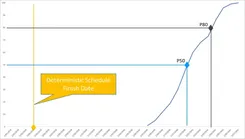
Given the system we are scheduling has a huge number of inherent variables, why are we not incorporating variability and running stochastic models as a standard process for our mine schedules?? We’re never going to create “better” mine schedules while we continue to run mine schedules on a deterministic basis, that is they have no variability in the inputs and so produce a single output.