Have you ever noticed that when a mine schedule is wrong, it’s always wrong on the downside?
In my previous article, I wrote about why mine scheduling doesn’t work, in this article I want to take that work and highlight why the problem is even worse. But to get the most from this article, I would strongly suggest you click here and read my previous article first.
If the schedule was wrong on the upside instead, that would be a nice luxury to have. The result would be that activities would finish early, or the mine site would operate with high inventories. Not such a bad problem to have!
But it never works that way…………
It’s always the opposite, instead the activity finishes late, resulting in reduced inventories, equipment being parked up, and potential scrambling to mine sufficient product. Why is that?
In my previous article, I discussed that the issue of ignoring variability in mine scheduling was a significant detriment to the accuracy of the resultant schedule. To highlight the issue, in that article I provided example calculations of the total variation if normal distributions were applied. In that article, I kept it very simple and the reason for the use of normal distributions, was that it allowed me to carry out mathematical calculations for the range of total production times.
But mining production distributions in the real world, will rarely be represented by a normal distribution, that assumption is an over-simplification. Production is much more likely to be represented by a left-skewed distribution.
In Figure 1 and Figure 2 below, I have plotted actual daily production results over a nine-month period for an electric shovel in Figure 1 and a dragline in Figure 2. In both charts, the actual results are represented by blue lines. On those graphs, I have also plotted in red, a typical normal distribution that matches the assumptions I used in my simplistic calculations in the previous article. That is, the normal distribution has a standard deviation that is 30% of the mean. (Note that for comparative purposes, scheduled downtime has been excluded from the actuals plotted)
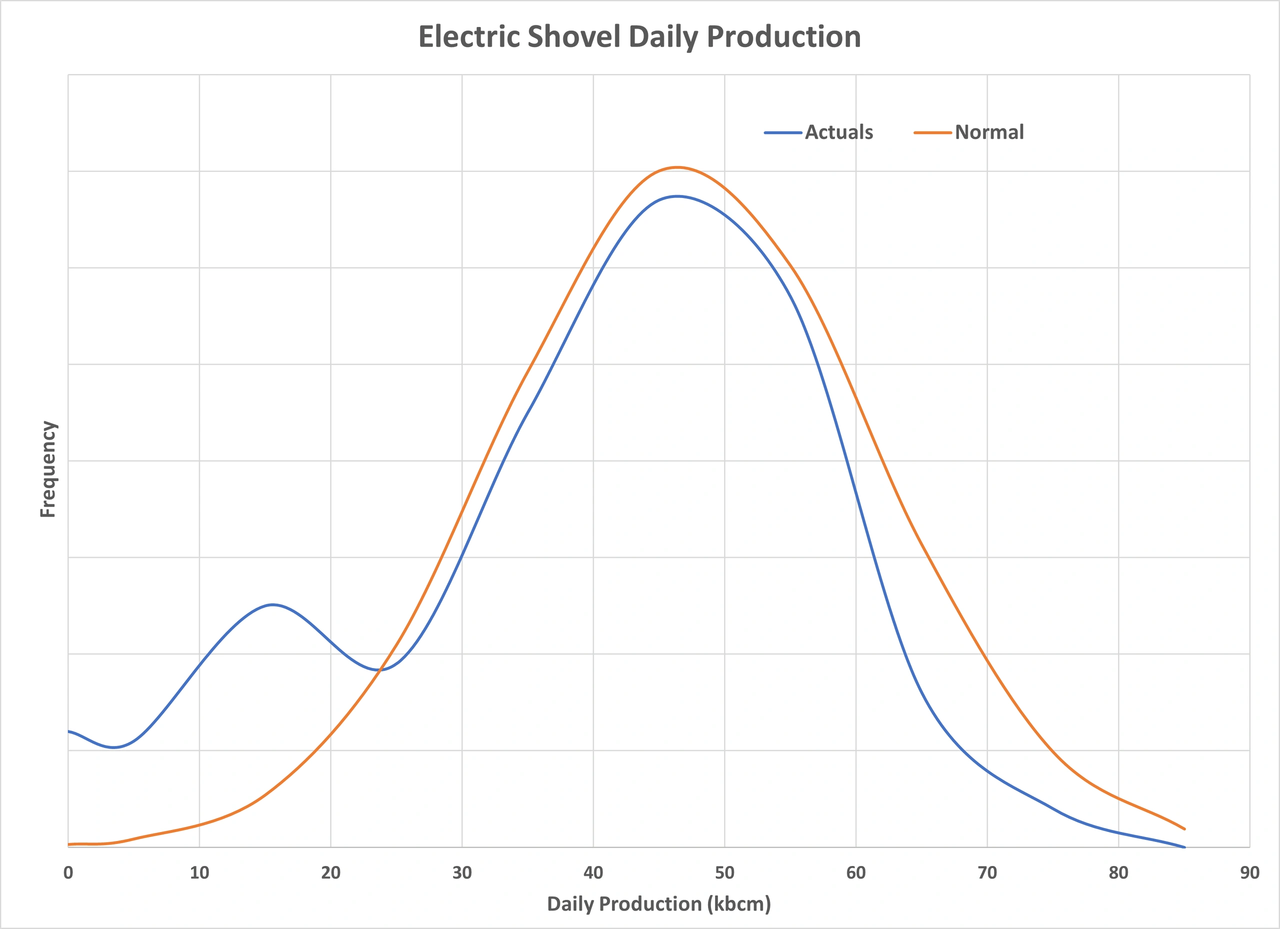
Figure 1 – Electric Shovel Daily Production
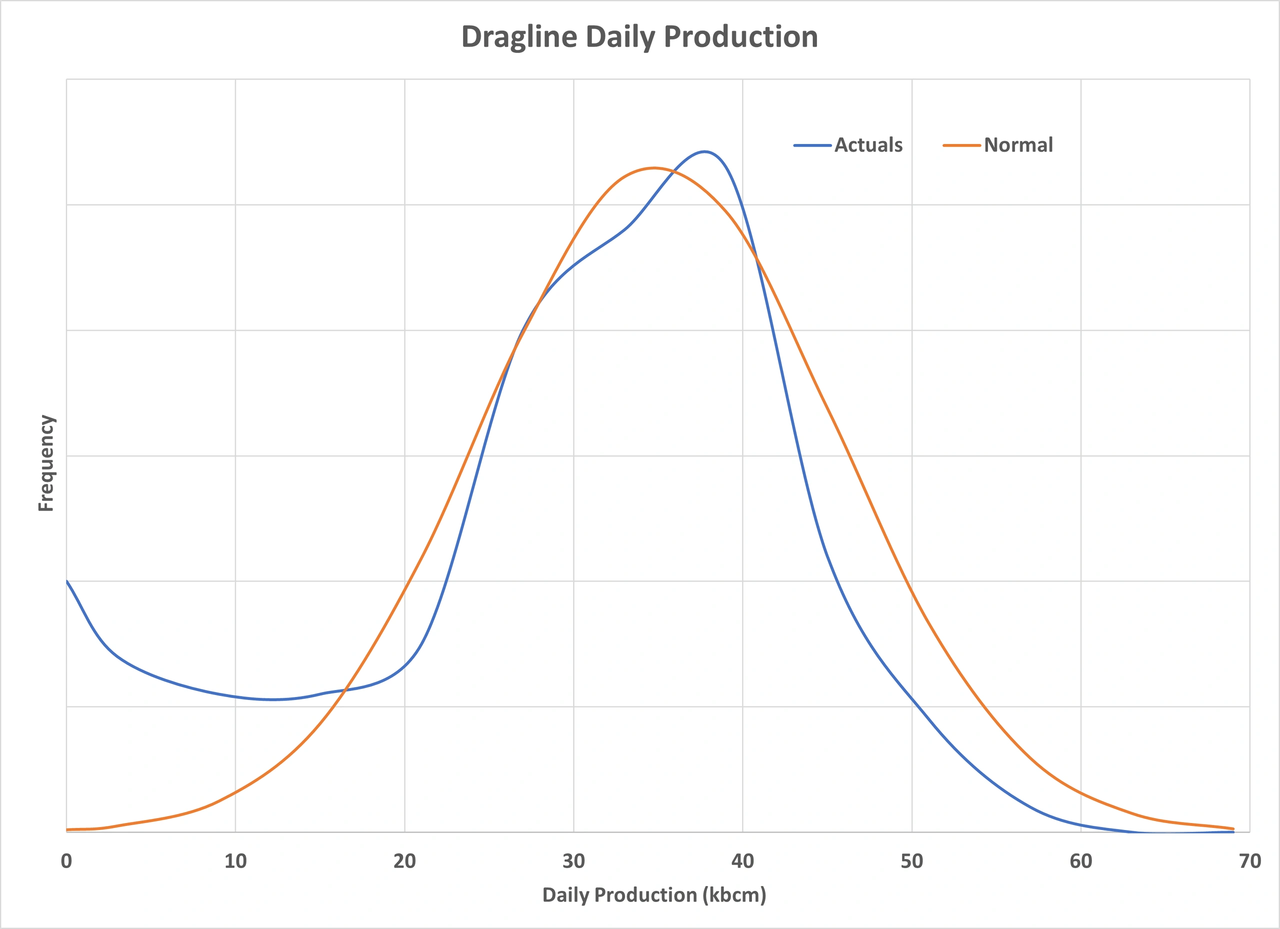
Figure 2 – Dragline Daily Production
The blue lines (actuals) in both charts have a tail to the left (left-skewed). If you think about it, that’s entirely logical. The assumed production hours and productivity rates used in the mine schedule will generally have very little upside available in them. During execution, it is generally only possible to create small reductions in delays such as meal breaks or wait on equipment, or small improvements in productivity rates over those planned. However, it is distinctly possible that delays could be significantly larger than planned, for example, major unplanned maintenance downtime, weather delays, or equipment idle time. Similarly, productivity could be dramatically reduced by a poor blast or inclement weather. So while typically there is very little upside potential on planning assumptions, it is common (and very easy) for significant downside to occur.
The outcome of a left-skewed distribution is periods of reduced productivity, where that productivity reduction is even greater than the scenario where a normal distribution had been built into the scheduling. This leads to activities taking longer than planned, leading to schedule conflicts and ultimately, failure to meet schedule targets. So unfortunately, more often than not, a mine schedule is going to surprise on the downside, rather than the upside.
Of course, this highlights another issue worthy of discussion in a future article. That is the issue of lost opportunities. Every time equipment is capable of working but isn’t actually working, or is working at a rate lower than capacity – that is a lost opportunity. For example, every time the shovel bucket is in hang mode due to under-trucking, or a drill is parked up waiting for bench preparation to finish, or dragline productivity is reduced due to hard digging, that is lost production that can’t be regained. Mine sites should focus on minimising those lost opportunities and hopefully, the introduction of left-skewed distributions into mine scheduling might help to highlight this issue and facilitate improvement.