This is one of those idiosyncrasies in production that is entirely logical when you sit back and analyse it, but we’re typically too busy in the process of mine design and planning, to have the time to sit back and appreciate. Thanks to Hendrik Lourens for his comment on my previous article, which reminded me about this issue.
Mine sites traditionally try and size the fleet capacity for each activity so that it is equivalent to the fleet capacity for each of the other activities. So for example, if the mine excavates 50 Mbcm per annum of waste per annum, then the drill fleet will generally have an annual capacity of 50 Mbcm or slightly more. This is called a balanced system.
That all seems very logical and the best way to size your fleet and run your mine. But there is a problem with a balanced operation and the greater the variability, the greater the problem! As always, the easiest and most effective way to show this is by the use of an example.
Let’s take our theoretical mine from Article 7, where we tested what happens at a mine with 6 sequential activities that all have a mean completion time of 10 days each. So this example is perfectly balanced, where every activity takes the same time. The mean period from drilling the waste, to railing the coal to the port, is a total of 60 days. The activities are as follows:
- Drill
- Blast
- Waste Excavation
- Coal Mining
- Coal Washing
- Railing
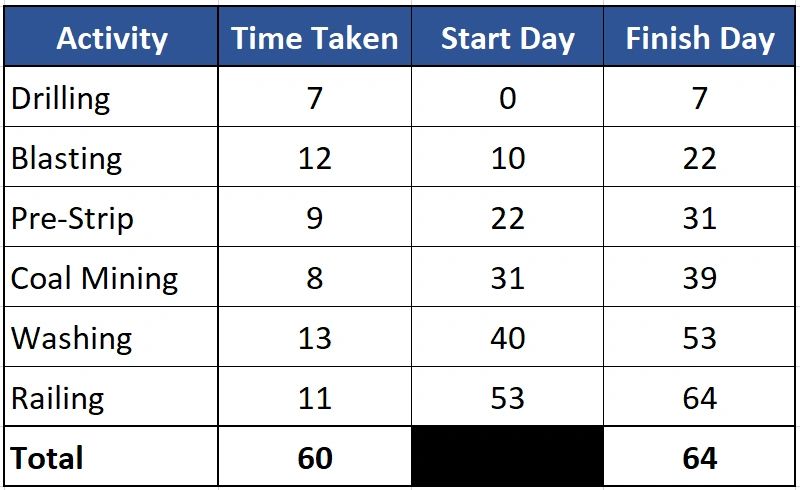
But each of these activities does not take exactly 10 days, they take 10 days “on average”. In the table below, I have applied an example set of actual times for each activity which vary around the mean. These are in the column labeled “Time Taken”. For this example, the total time taken of all the activities adds to 60 days, which is the same as the sum of the mean times for each of the activities. The last 2 columns detail the start and end day for each of the activities.
Now, let’s review the table in detail:
- Drilling starts on Day 0 and only takes 7 days. So drilling finishes on Day 7, three days ahead of our deterministic schedule (the mean time for the Drilling activity).
- However, because the mine is balanced and we don’t have spare capacity idling waiting for a task, Blasting is likely to be still completing another task elsewhere in the mine. So Blasting is not available to start until it completes that previous activity, which has an expected time of Day 10. This could obviously be earlier, or later than Day 10, but for this example, we will assume it finishes at the expected time.
- Blasting will subsequently still start on Day 10 and this activity takes 12 days, so therefore finishes on Day 22, now two days behind schedule.
- Pre-Strip takes 9 days, putting us now one day behind schedule.
- Note that if Pre-Strip completed its prior activity at the expected time, it will be idle for 2 days, waiting for this block to be available to dig.
- Coal Mining takes 8 days, finishing on Day 39 and now putting us one day ahead of plan. However, with a balanced operation, the coal plant is still washing other coal and is not expected to start on this batch of coal until Day 40.
- Note that if Coal Mining completed its prior activity at the expected time, it will be idle for 1 day, waiting for this block to be available to mine.
- Washing starts on Day 40 and finishes on Day 53, so back 3 days behind schedule again.
- Railing starts on Day 53 and finishes on Day 64, 4 days behind the deterministic schedule of 60 days that was based on mean values for each activity. So even though the total time for each of the activities was 60 days, the sequential operation actually took 64 days.
- Note that if Railing completed its prior activity at the expected time, it will be idle for 3 days, waiting for this coal to be available to rail.
It is evident in this example that due to the nature of mining, which is a continuous set of activities, each dependent on the completion of a previous activity, gains were actually lost in the system (unless the next activity was idle and ready to go). However, as soon as a loss occurred, it was retained in the system and passed onto the next activity, therefore accumulating through the system and resulting in lost time of 4 days.
Now, of course, this is a very simple example and mines are significantly more complex than this, with many other issues at play. But it serves the purpose of highlighting how inter-dependency between activities plays a critical role. In the example above, the first activity of Drilling actually finished early and there was a gain of 3 days. But for that gain to pass through the system, then blasting would have to finish its previous task 3 days early, Pre-Strip would have to finish its previous task 3 days early, and so on, all the way through to the last activity of Railing.
If we assume that every activity is normally distributed then there is a 50% probability of each activity finishing early. The probability of 5 activities (Blasting through to Railing) all finishing early is 3%. And given each activity is normally distributed, the probability of them all finishing 3 days early is significantly less than 3%. So in this simple example, unless we have spare capacity planned within the system, there is less than a 3% probability of the gains passing all the way through the system. And if the activity time periods are not normally distributed, but as discussed in my previous article are instead actually left-skewed distributions, then the probability even further reduced.
So what do mine sites do to try and mitigate this issue? Schedules usually target carrying inventory in front of every activity in the process and typically lots of it! The cost of that inventory across every activity is substantial when you accumulate them across the numerous sequential activities that happen within a mine site. But even with all that inventory, most mines still consistently run into schedule conflicts that lead to idle equipment, or equipment having to relocate.
The example above also helps to highlight another issue briefly mentioned in my previous article, that is the issue of “lost opportunities”. In the table, you can see that Pre-Strip was ready to start on Day 20, but because Blasting was running late, Pre-Strip couldn’t start until Day 22. That is a 2 day lost opportunity that can’t be recouped, similarly with Coal Mining at 1 day and Railing at 3 days. There will be more to come on this in a future article, when I start writing about another significant issue in mining, the use of key performance indicators (KPIs)!
I started out with one article on the role that variability plays in mine scheduling, but due to its fundamental importance and the fact that most mines still carry out deterministic scheduling, I eventually wrote three articles on this subject. But variability doesn’t only play out as an issue that negatively affects mine scheduling issue, it negatively affects execution and costs. Production variability leads to the need to carry larger inventories (cost), it leads to lost time opportunities (execution) and also increases the likelihood of a conflict within the mining schedule, requiring the mine to be rescheduled (scheduling).
As posted by Steve Hadwen in a comment on my previous article, instead of focussing on larger equipment or other capital investments to lift the mean production levels, maybe mine sites should be focussing on minimising the downside instead and shortening the left side tail of the skewed distribution? This will have the effect of lifting overall production and the added bonus of reducing variability, which allows the possibility of operating with smaller inventories.
So after three articles discussing the flaws of scheduling without incorporating production variability, I’m looking forward to now writing some articles that discuss solutions. Stay tuned!!
This article is the ninth in a series of articles on various issues and topics relating to mine scheduling. If you found this article beneficial, you can always go back to the first article here and read through the series in order.
For other articles like this and quality conversations on a range of mining engineering subjects, I’d encourage you to join the LinkedIn Group called MinErs Digs, click here.